
Chicago Street Guide PDF: A Comprehensive Plan
Navigating the vibrant city of Chicago demands reliable resources, and PDF street guides offer a convenient, detailed solution for residents and visitors alike.
These digital maps encompass everything from socio-economic data to park locations, providing a comprehensive overview of the urban landscape.
Accessing these guides, often available through the City of Chicago website or Archive.org, ensures efficient route planning and exploration.
Chicago, a metropolis renowned for its iconic architecture and complex network of streets, has long relied on detailed street guides for navigation. Historically, these guides were physical maps, but the digital age has ushered in the era of the Chicago Street Guide PDF. These PDFs represent a powerful evolution, offering accessibility and functionality previously unavailable.
From meticulously documented socio-economic tier maps based on census data, to comprehensive listings of 49 parks and recreational facilities, these guides provide more than just routes. They offer a contextual understanding of the city’s diverse neighborhoods. The availability of historical maps, scanned with high quality by institutions like the Eastern Institute of Chicago, adds another layer of depth.
Whether you’re a long-time resident, a visitor, or a professional like a trucking dispatcher needing efficient route planning, a Chicago Street Guide PDF is an invaluable tool. They represent a fusion of traditional cartography and modern technology, designed to enhance urban exploration.
What is a Chicago Street Guide PDF?
A Chicago Street Guide PDF is a digital, portable document format version of a traditional street map of Chicago. Unlike interactive online maps, a PDF offers a static, downloadable representation of the city’s streets, landmarks, and often, additional layers of information.
These PDFs frequently include detailed street networks, clearly labeled streets, and crucial points of interest. They can incorporate socio-economic data visualized by census tract, providing insights into different areas of the city. Some guides, like those from Archive.org, are high-quality scans of historical maps, offering a glimpse into Chicago’s past.
Essentially, it’s a self-contained map that can be viewed on any device with a PDF reader, printed for offline use, and shared easily. They are a valuable resource for anyone needing a comprehensive and readily accessible map of Chicago, whether for dispatching routes or simply exploring the city.
Why Use a PDF Street Guide?

PDF street guides offer several advantages over relying solely on online maps. They provide offline access, crucial when navigating areas with limited or no internet connectivity – a benefit for dispatchers managing flatbed or step deck equipment across the city.
Unlike dynamic maps, PDFs maintain a consistent view, preventing unexpected changes or updates during route planning. They are also easily printable, offering a tangible map for those who prefer a physical copy. The inclusion of socio-economic tier maps within some PDFs provides valuable contextual information.
Furthermore, PDFs are universally compatible, viewable on various devices with a PDF reader. This accessibility, combined with the detailed information – including park locations and street layouts – makes them ideal for both residents and visitors seeking a reliable and comprehensive Chicago map.

Types of Chicago Street Guides Available as PDFs
Chicago offers diverse PDF street guides, including official city maps, third-party options, and valuable historical maps detailing past layouts and socio-economic tiers.
Official City of Chicago Street Maps
The City of Chicago frequently provides official street maps in PDF format, representing the most current and authoritative source for navigational information. These maps are meticulously maintained, reflecting recent infrastructure changes, street name updates, and the inclusion of vital points of interest.
Typically, these PDF guides showcase a detailed street network, clearly labeled streets, and often incorporate information regarding public transportation routes. They serve as an invaluable resource for both residents and visitors needing accurate and up-to-date guidance. Accessing these maps directly from the city ensures reliability and minimizes the risk of outdated information.
Furthermore, some official releases may include socio-economic data presented through census tract maps, offering a broader understanding of the city’s demographics. These maps, often scanned with high quality, provide a comprehensive view of Chicago’s urban landscape.
Third-Party Chicago Street Guide PDFs
Beyond official city resources, numerous third-party providers offer Chicago street guide PDFs, catering to diverse needs and preferences. These alternatives often present unique features, such as enhanced visual styling, specialized indexes of points of interest – including parks and recreational facilities – or integration with other mapping services.
While convenient, it’s crucial to verify the accuracy and currency of these PDF maps, as updates may not align with official city revisions. Some providers specialize in historical maps, offering fascinating glimpses into Chicago’s past street layouts. These historical PDFs, like those found on Archive.org, are often high-quality scans of original documents.
Users should compare information across multiple sources to ensure reliability, especially when relying on these guides for critical navigation or logistical planning.
Historical Chicago Street Maps (PDFs)
Delving into Chicago’s past is readily achievable through readily available historical street maps in PDF format. These digitized documents, often sourced from institutions like the Eastern Institute of Chicago, provide a captivating look at the city’s evolution over time. They reveal how the street network has transformed, showcasing former neighborhoods and lost landmarks.
Archive.org serves as a valuable repository for these PDF treasures, offering high-quality scans of maps dating back decades. Examining these maps can be particularly insightful for genealogical research or understanding the historical context of specific locations. However, users should remember that these maps reflect the city as it was, and may not accurately represent current infrastructure.
Comparing historical layouts with modern Chicago street guide PDFs highlights the dramatic changes the city has undergone.

Key Features to Look for in a Chicago Street Guide PDF
Essential features include a detailed street network, clear labeling of landmarks, a comprehensive index, and accurate scale indicators for effective navigation.
Detailed Street Network
A truly useful Chicago street guide PDF hinges on the intricacy of its street network depiction. The map should illustrate not just major thoroughfares like Michigan Avenue or Lake Shore Drive, but also a comprehensive rendering of residential streets, alleys, and even pedestrian walkways where available.
High-resolution scans, like those from the Eastern Institute of Chicago, are crucial for clarity. The network needs to accurately reflect Chicago’s grid system, particularly in areas like downtown, while also showcasing the more organic layouts found in older neighborhoods.
Furthermore, the guide should clearly differentiate between one-way streets and those allowing two-way traffic. The inclusion of highway ramps and expressways, accurately labeled with route numbers, is also paramount for long-distance travel planning within the metropolitan area. A detailed network empowers users to find the most efficient routes, avoiding congestion and maximizing travel time.

Clear Labeling of Streets and Landmarks
Effective Chicago street guide PDFs prioritize legible and unambiguous labeling. Street names must be prominently displayed, utilizing a font size and style that remains readable even when zoomed out. Avoiding overlapping labels is critical, especially in densely populated areas like downtown Chicago.
Beyond streets, the guide should clearly identify key landmarks – parks (like Loyola Park or Hiawatha Park), public buildings, hospitals, and major commercial centers. These landmarks serve as vital reference points for navigation.
Consistent labeling conventions are essential; for example, using a specific color or font weight for expressway names. The inclusion of mile markers or distance indicators, as seen in some Chicago street maps, further enhances usability. Clear labeling transforms a complex map into an accessible navigational tool.
Index of Streets and Points of Interest
A truly useful Chicago street guide PDF incorporates a comprehensive index. This index should list all streets alphabetically, providing corresponding grid coordinates or page numbers for quick location. Beyond streets, an index of points of interest is invaluable.
This index should categorize landmarks – parks (listing the 49 facilities documented), recreational areas, hospitals, government buildings, and transportation hubs. Cross-referencing these points of interest with their addresses, as found in available listings, is crucial.
The index should be easily searchable within the PDF reader. A well-designed index eliminates the need to visually scan the entire map to find a specific location, significantly improving the user experience and efficiency of navigation within Chicago.
Scale and Distance Indicators
Essential for accurate navigation, a Chicago street guide PDF must prominently display a clear scale indicator. This allows users to accurately estimate distances between locations, crucial for trip planning and understanding geographical relationships.
The scale should be presented in both miles and kilometers to cater to a wider audience. Distance indicators, such as mile markers along major streets (as seen in documented Chicago maps), further enhance usability.
Furthermore, the PDF should include a statement regarding map projection and potential distortions. A legend explaining symbols used for different road types and landmarks is also vital. Accurate scale and distance information transforms the PDF from a visual aid into a practical tool for precise route calculation.

Finding and Downloading Chicago Street Guide PDFs
Locating these valuable resources is straightforward; explore the Official City of Chicago website, reputable online map providers, and Archive.org for accessible PDF downloads.
Official City of Chicago Website
The City of Chicago’s official website serves as a primary hub for accessing various street-related resources, potentially including downloadable PDF street guides or links to interactive maps that can be saved as PDFs.
While a direct, comprehensive PDF street guide isn’t explicitly mentioned in the provided context, the website likely hosts detailed maps showcasing the street network, socio-economic tier information based on census tract data, and locations of parks and recreational facilities – all elements commonly found within a robust street guide.
Users should navigate the city’s data portal and planning departments to uncover available map products. Furthermore, information regarding public transportation routes, which are crucial for navigating the city, may be integrated with street maps available for download or viewing. Regularly checking the website for updates is recommended, as available resources can change over time.
Exploring the official channels ensures access to the most accurate and up-to-date information directly from the source.
Online Map Providers Offering PDF Downloads
Numerous online map providers, beyond the official City of Chicago website, may offer Chicago street maps available for download as PDF files. While the provided text doesn’t name specific providers, a search utilizing keywords like “Chicago street map PDF” will yield various results.
These maps often present a detailed street network, clear labeling of streets and landmarks, and potentially include a scale and distance indicators for accurate navigation. Some providers might offer specialized maps, such as those highlighting public transportation routes or socio-economic tiers based on census tract data.
Users should exercise caution and verify the source’s reliability before downloading any map. Look for reputable providers known for accurate and updated cartographic information. Always scan downloaded files for malware before opening them. These resources can supplement official city maps.
Archive.org and Historical Map Collections
Archive.org stands as a valuable repository for historical Chicago street maps in PDF format. This digital library offers a glimpse into the city’s past, showcasing street layouts and landmarks from different eras. These historical PDFs, often scanned in high quality by institutions like the Eastern Institute of Chicago, provide a unique perspective on urban development.
Researchers and history enthusiasts can explore how Chicago’s streets have evolved over time. These collections may include maps detailing socio-economic tiers from past census data, offering insights into the city’s demographic shifts. Accessing these resources is typically free, but users should respect copyright restrictions and usage guidelines. They are a treasure trove for understanding Chicago’s urban history.

Utilizing a Chicago Street Guide PDF Effectively
PDF reader software unlocks features like zooming and navigation, enhancing map usability. Printing options allow for tangible copies, aiding offline route planning and exploration.
PDF Reader Software and Features
Utilizing a robust PDF reader is crucial for maximizing the benefits of a Chicago street guide PDF. Modern software, such as Adobe Acrobat Reader or Foxit Reader, offers a suite of features designed for optimal map viewing and interaction.
Key functionalities include high-resolution zooming, allowing detailed examination of street networks and landmarks. Layered viewing enables toggling between different map elements, such as street names, park locations, or socio-economic tier data.
Search capabilities are invaluable for quickly locating specific addresses, streets, or points of interest. Furthermore, many readers support annotation tools, permitting users to mark routes, highlight key locations, or add personalized notes directly onto the map.
Advanced features like measuring tools can determine distances between points, while the ability to rotate the map can aid in orientation. These tools transform a static PDF into a dynamic and interactive navigation resource.
Zooming and Navigation Techniques
Effectively navigating a Chicago street guide PDF relies on mastering zooming and panning techniques. Start with a broad overview to grasp the city’s layout, then progressively zoom in to focus on specific neighborhoods or streets.
Utilize the PDF reader’s zoom tools – often a slider or percentage input – to achieve the desired level of detail. For precise location finding, zoom to a level where street names and landmarks are clearly legible.
Panning, or dragging the map view, allows exploration of adjacent areas without losing context. Many readers offer a “hand” tool for intuitive panning. Consider using the reader’s search function to quickly jump to a specific location, then zoom in for detailed examination.
Remember to periodically zoom out to re-orient yourself and understand the surrounding area. Combining these techniques ensures efficient and accurate navigation of the Chicago street map.
Printing Options and Considerations
Printing a Chicago street guide PDF requires careful consideration to ensure readability and usability. Before printing, access the PDF reader’s print settings to adjust scaling. Select “Fit to Page” to maximize the map’s size within the paper boundaries, or adjust the percentage for a custom scale.
Orientation – portrait or landscape – depends on the map’s layout. Preview the print to confirm proper alignment. For large-format maps, consider using a plotter or printing across multiple pages, utilizing the “Tile” or “Poster” option.
Paper quality impacts clarity; heavier weight paper is recommended for durability. Be mindful of ink consumption, especially for color maps. High-quality printing ensures a legible and useful physical copy of your Chicago street guide.
Always test print a small section before committing to the entire document to verify settings.
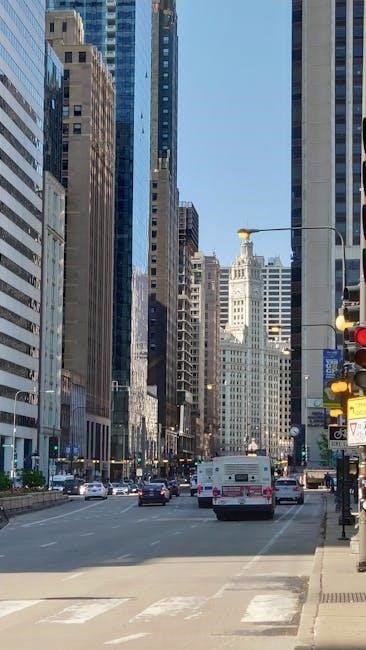
Chicago Neighborhoods and Street Guide Relevance
PDF street guides are crucial for navigating Chicago’s diverse neighborhoods, from Downtown’s grid to the North and South Sides’ unique layouts.
Detailed maps aid exploration.
Downtown Chicago Street Layout
Downtown Chicago boasts a remarkably organized street layout, largely based on a grid system originating from the Chicago River. A Chicago Street Guide PDF is invaluable for understanding this structure, clearly displaying major arteries like State Street, Michigan Avenue, and Wacker Drive.
These PDF maps detail distances from a central point, aiding navigation. The grid is interrupted by diagonal streets like Michigan Avenue, created after the Great Chicago Fire, and the guides accurately represent these deviations.
Understanding the numbered streets running east-west and numbered avenues running north-south, as depicted in a detailed PDF, is key to efficient travel. Furthermore, the guides often integrate socio-economic tier information, providing context to the urban landscape. They also show the location of parks and recreational facilities.
A quality PDF will highlight landmarks and facilitate easy orientation within this bustling core.
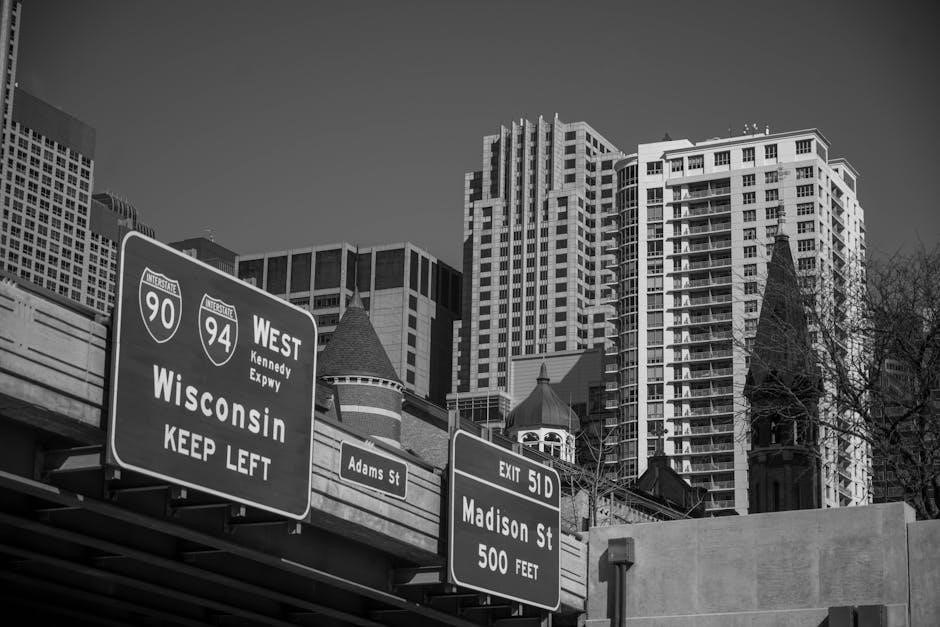
North Side Neighborhood Street Guides
Chicago Street Guide PDFs prove particularly useful for navigating the diverse North Side neighborhoods. Areas like Lincoln Park, Lakeview, and Uptown exhibit unique street patterns, often deviating from the downtown grid. Detailed PDF maps showcase these intricacies, highlighting local streets and points of interest.
These guides often include information on parks, such as Loyola Park, and integrate socio-economic data by census tract, offering a broader understanding of each community. The clarity of street labeling and the inclusion of distance indicators are crucial for unfamiliar visitors.
A comprehensive PDF will also display major transportation routes, aiding commuters. Accessing these guides digitally allows for easy zooming and printing, facilitating both digital and physical navigation. They are essential for exploring the North Side’s residential areas and vibrant commercial strips.
Finding these resources on the City of Chicago website or Archive.org is straightforward.
South Side Neighborhood Street Guides
Chicago Street Guide PDFs are invaluable for exploring the South Side’s rich tapestry of neighborhoods, including Hyde Park, Bronzeville, and Beverly. These areas possess distinct layouts and historical streetscapes, best understood with detailed mapping resources.
A quality PDF street guide will clearly delineate the street network, showcasing local roads and landmarks. Integration of socio-economic tier maps, based on census tract data, provides context to the area’s diverse communities. Access to information regarding parks, like Hiawatha Park, enhances the user experience.
Effective guides also incorporate public transportation routes, crucial for navigating the South Side. Digital PDF formats allow for convenient zooming, printing, and searching. These resources, obtainable from the City of Chicago and Archive.org, empower residents and visitors to confidently explore this vibrant part of the city.

Additional Information Found in Chicago Street Guides
Chicago Street Guide PDFs often include listings of parks and recreational facilities, socio-economic data, and integrated public transportation routes for comprehensive navigation.
Parks and Recreational Facilities (PDF Listings)
Chicago Street Guide PDFs frequently dedicate sections to detailing the city’s extensive network of parks and recreational facilities. These listings, often presented in tabular format, provide crucial information for residents and visitors seeking outdoor spaces.
Documents may include the names and addresses of parks, ranging from well-known landmarks like Loyola Park and Hiawatha Park, to smaller neighborhood green spaces. Some guides even categorize parks based on amenities, such as playgrounds, sports fields, or walking trails.
PDF format allows for easy searching and printing of these lists, making it convenient to plan outings. The inclusion of park details within street guides enhances their utility, transforming them from simple navigation tools into comprehensive resources for leisure and recreation within Chicago.
These listings contribute significantly to the overall value of the guide.
Socio-Economic Tier Maps (Census Tract Data)
Chicago Street Guide PDFs can extend beyond basic cartography, incorporating valuable socio-economic data visualized through tier maps based on census tract information. These maps divide the city into distinct tiers, often ranging from one to four, representing varying levels of economic prosperity.
Tier 1 typically indicates the highest socio-economic status, while subsequent tiers denote progressively lower levels. This data, derived from census information, provides insights into income levels, education attainment, and other demographic factors within specific neighborhoods.
Such maps, often scanned in high quality, are invaluable for urban planning, real estate analysis, and understanding the city’s socio-economic landscape. The integration of this data within a street guide PDF offers a powerful tool for contextualizing geographic locations and understanding community dynamics.
These maps are often created by institutions like the Eastern Institute of Chicago.
Public Transportation Routes (Integration with Street Maps)
Chicago Street Guide PDFs frequently enhance their utility by integrating detailed public transportation routes directly onto the street maps. This overlay allows users to visualize bus lines, ‘L’ train tracks, and station locations in relation to the city’s street network.
Effective integration means users can easily plan multi-modal journeys, combining walking, driving, and public transit. The maps often display route numbers and key stops, facilitating seamless navigation for both residents and tourists.
This feature is particularly valuable in a city like Chicago, known for its extensive public transportation system. PDF format allows for zoom functionality, enabling detailed examination of specific routes and connections. The combination of street detail and transit information creates a comprehensive navigational resource.
This integration simplifies commuting and exploration throughout the city.